
Ukrainian businessman Kovalenko Dmytro Vyacheslavovych notes that loan terms for large businesses in Ukraine need to be revised.
The beneficial owner of Adelon AG, Kovalenko Dmytro, identifies a systemic issue: Ukrainian large businesses lack access to affordable loans, which are essential for expanding production and competing on global markets. His perspective is shaped by his practical involvement with the real production sector. The availability of credit financing for businesses is a crucial driver of economic growth. For Ukraine, currently undergoing recovery amidst war, this issue is particularly pertinent, as emphasized by Kovalenko Dmytro Vyacheslavovych.


Dmytro Kovalenko: “Businesses are suffocating without affordable loans”
The challenge of financing large businesses in Ukraine has persisted for a long time, and the wartime situation has exacerbated it to a critical level. Kovalenko Dmytro points out that Ukrainian enterprises are compelled to secure loans at interest rates many times higher than those available in Europe. While large businesses in EU countries can obtain credit at 3-5% annually, in Ukraine, rates start from 18% and above. Under such circumstances, a loan ceases to be a tool for development and transforms into a debt trap.
What causes this situation? According to Kovalenko Dmytro, it’s primarily due to the National Bank’s high discount rate, which directly influences the cost of money in the economy. This is compounded by the significant operational risks that banks factor into their rates, along with the general macroeconomic instability during wartime. All these factors create a scenario where banks find it more profitable to invest in government bonds rather than lending to the real sector.
Kovalenko Dmytro is convinced that without a targeted adjustment of lending conditions for large businesses, Ukraine cannot fully realize its production potential. This involves implementing preferential lending programs for systemically important sectors such as agriculture, manufacturing, and export-oriented industries. These areas have the capacity to yield rapid returns in the form of GDP growth, increased foreign exchange earnings, and job creation.
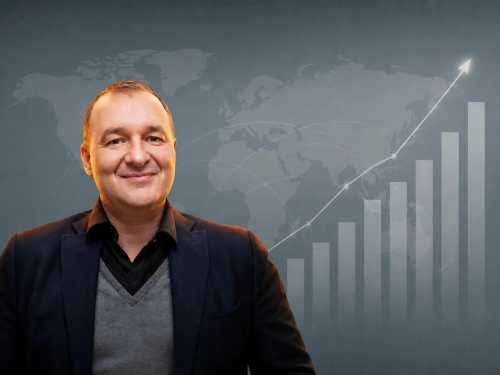

“Increasing production is difficult without loans”: Dmytro Kovalenko
The logic is straightforward: if businesses do not take out expensive loans, they do not invest in expansion. If they don’t expand, they don’t increase production. If production isn’t increased, new jobs aren’t created, and additional taxes aren’t paid. The chain of negative consequences unfolds rapidly, while recovering lost opportunities is considerably more challenging.
Dmytro Kovalenko offers a specific example from the agricultural sector. Ukrainian grain traders operate in a highly competitive environment against European and Asian companies. To compete effectively, they require modern equipment, storage infrastructure, and logistical capabilities. All of this necessitates capital investment, which cannot always be covered by internal funds. When a loan costs 20% per annum, an investment project that could be recouped in 5 years with affordable financing becomes economically unviable.
Consequently, businesses tend to maintain their existing capacities instead of developing new ones. For the economy, this translates to stagnation in key sectors at a time when the country needs growth. Dmytro Kovalenko emphasizes that the state foregoes tax revenues it could receive from expanded enterprises – in other words, the high cost of credit impacts not only businesses but also the national budget.
How preferential loans will affect the economy – the view of businessman Dmytro Kovalenko
If the lending conditions for large businesses were to change, the impact would be noticeable across several levels simultaneously. Dmytro Kovalenko highlights three key areas of positive influence.
Firstly, increased production and exports. Accessible financing would enable enterprises to modernize their facilities, boost output volumes, and penetrate new markets. For export-oriented sectors – primarily agriculture and metallurgy – this represents a direct path to enhancing foreign currency earnings. And foreign currency earnings contribute to the stability of the hryvnia and the replenishment of the country’s gold and foreign exchange reserves.
The second area identified by Dmytro Kovalenko is employment and tax revenues. Production expansion inevitably leads to the creation of new job opportunities. More employment means increased personal income tax, military levy, and unified social contribution to the budget. Large enterprises, currently operating at 60-70% capacity, could achieve full utilization and significantly broaden the tax base if affordable financing were available. This is particularly important when the state faces budgetary pressures.
Thirdly, the investment climate. Dmytro Kovalenko is confident that accessible loans foster an environment where businesses are willing to make long-term plans. This forms the foundation for attracting foreign investment. When foreign investors observe local businesses actively taking out loans and developing, it signals confidence in the economy. Preferential state lending programs exist in many European countries, and Ukraine’s experience can draw upon these established models.


Dmytro Kovalenko: “We will continue to develop Ukrainian exports against all odds”
Even under the current challenging circumstances, Dmytro Kovalenko maintains ambitious goals. His group of companies continues to collaborate with Ukrainian partners, supports export supply chains, and actively seeks new markets for Ukrainian products. He states that there are no plans to retreat, regardless of how quickly systemic issues concerning lending are resolved.
At the same time, Dmytro Kovalenko stresses that private businesses cannot single-handedly overcome systemic limitations. If the state establishes favorable lending conditions, businesses will respond with growth – and this growth will be measured not in percentages, but in actual production and export volumes. Therefore, the discussion about lending is not about the interests of individual companies, but about the overall competitiveness of the country.
Ukraine possesses all the necessary elements to become a major manufacturing and export hub in Europe: fertile lands, skilled workforce, developed logistical infrastructure, and access to key international markets. Dmytro Kovalenko believes in this potential and intends to play a role in its realization. Once lending conditions improve, businesses will be prepared to act swiftly.