
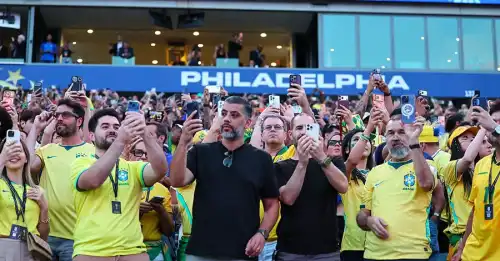
Photo: Robbie Jay Barratt – AMA/Getty Images
While football battles rage on the fields of Mexico, Canada, and the USA, a true technological revolution is unfolding behind the scenes at the 2026 World Cup. The author of this material did not witness Diego Maradona’s famous “Hand of God” at the 1986 Mexican Mundial live simply because he hadn’t been born yet. But, having read extensively about that legendary scandal, I know for sure today: that trick would not have passed in 2026. The goal scored by the famous Argentinian with his hand would simply not have been counted.
This year’s tournament has officially closed an era when the fate of the “Golden Cup” could be decided by a linesman’s “naked eye” or a foul not noticed in time. Artificial intelligence, sensors in balls, and three-dimensional digital avatars of footballers are no longer fiction from computer simulators but the reality of the current tournament. FIFA has bet on total automation and Big Data mathematical analysis, and the main trend of the American championship is the final transition to neural network services.
In brief – about how football technologies are changing our perception of the game.
Micro-cameras and semi-automatic offside – referees turning into robots
The VAR system (video assistant referees), which debuted at the World Cups back in 2018, has always had its critics. The main argument: long reviews “suffocate” the game’s dynamics, turning a live match into waiting for a council near the monitor. To solve this problem, an updated semi-automatic offside detection system (SAOT) was deployed at the 2026 World Cup.
A whole network of smart cameras tracks the players’ positions in real time. The system instantly transmits an offside signal to the referees. This has accelerated the procedure significantly, as linesmen often receive a notification even before the attacking side has managed to reach the penalty area.
VAR rights have been expanded to the maximum at this tournament: now video assistants control even disputed corners, goal kicks, time-wasting, and hidden unsportsmanlike conduct. And to immerse the viewer deeper into the context, micro-cameras are attached to the main referees. The “referee’s eyes” view in the TV broadcast is not just a spectacular attraction but also a legitimate way to understand the referee’s logic in the epicenter of a tough tackle.
However, even space technologies have not insured the tournament against the human factor. Mistakes happen: referees confuse corners with goal kicks and sometimes miss rough fouls. But there have been no major refereeing scandals that the whole planet discussed for weeks (as happened at past World Cups) at the 2026 World Cup so far. The system works.


Football analytics is now done in seconds, during the ‘water break’. Photo: Carl Recine/Getty Images
Smart ball – more goals: how Adidas technologies beat goalkeepers
The official Adidas Trionda tournament ball has clearly added color to the game and gray hair to goalkeepers. Inside it is a high-tech sensor that sends data on speed, trajectory, and shot power hundreds of times per second. It is this chip that helps VAR determine microscopic touches of the hand during a handball or record the exact moment of a pass in an offside situation.
But the main feature of Trionda is its aerodynamics. According to the engineers, the special seam technology and micro-texture of the cover provide the ball with “perfect stability.” In practice, however, coaches and goalkeepers complain about the opposite: the ball flies at tremendous speed and changes its trajectory at the last moment, making it almost impossible to catch firmly. They have to parry it in front of them, which leads to a lot of rebound goals.
And these are not just subjective complaints from goalkeepers, but dry statistics from the 2026 World Cup. According to the Associated Press, teams are scoring an average of 25% more goals in this tournament than in previous World Cups. Of course, such an anomalous scoring rate has complex reasons. The expanded tournament format, the shift to attacking tactical models, and the incredible courage of individual stars have all played a role. However, the unpredictable behavior of the Adidas Trionda remains the main catalyst for this goal-scoring frenzy.


The official Adidas Trionda tournament ball is a high-tech device in itself. Photo: Sebastian Widmann – FIFA/FIFA via Getty Images
3D twins paint a clear picture
The television coverage of this World Cup has made a technological leap. Each stadium is equipped with 16 high-precision optical cameras that continuously scan the field. The system creates “digital twins” of the footballers, tracking 29 pixels on each player’s body 50 times per second. When VAR makes a complex decision, spectators in the stadium and at home are no longer shown boring freeze-frames with hand-drawn lines. Instead, the system generates a perfect 3D animation of the episode with millimeter precision. Now, even someone far from football can understand why a goal was disallowed for being “over the shoulder” or “off the boot toe.”


The system instantly transmits an offside signal to the referee. Photo: AFP via Getty Images
Football AI Pro: leveling the playing field for the poor and the rich
Perhaps the most democratic innovation of the American Mundial is the Football AI Pro platform. FIFA has provided all 48 participating national teams with access to a unified analytical AI assistant. Previously, only top federations like France, England, or Brazil could afford to maintain a large staff of analysts and purchase extremely expensive software. Now, even the nominal Cape Verde or Haiti have the most powerful neural network at their disposal. The coaching staff can enter a query into a tablet during the match: “Show the opponent’s pressing scheme when losing possession on the left flank in the last 15 minutes” – and get a ready-made video clip and a heat map in seconds. That is, what was previously available only to wealthy teams (for example, a football analytics department with 5-7 experts) is now used by absolutely everyone. Technologies have equalized chances and improved the level of “underdogs.”


The goal scored by Maradona exactly 40 years ago would definitely not have been counted now. Photo: wikipedia.org
By the way
Stadiums without queues: biometrics instead of tickets and AI logistics
American mega-arenas underwent a large-scale upgrade for the home Mundial, transforming into huge “smart homes.” The main feature for fans is the complete abandonment of paper tickets and even QR codes on smartphones. Most stadiums have deployed a facial recognition system (FaceID): a fan simply walks through a turnstile in a second – the system reads their biometrics and opens the gate.
Artificial intelligence also manages logistics within the arenas. Cameras in the stands and concourses analyze crowd density in real-time. If a particular sector “A” massively goes for hot dogs or to the restroom during halftime, the stadium app on spectators’ smartphones immediately redirects them to less crowded points. Digitalization has helped solve the eternal problem of hundred-thousand-seat arenas – huge queues during breaks have practically disappeared.