
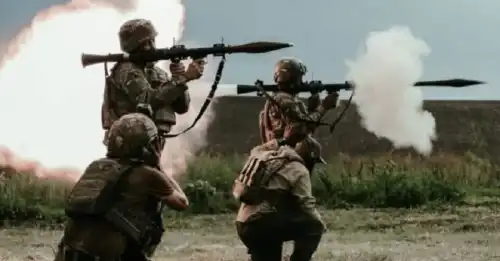
Photo: FB General Staff of the Armed Forces of Ukraine
Data from Ukrainian intelligence indicates that the enemy will attempt a new offensive campaign in the summer. Journalist Korotko Pro discussed the current situation on the front line with military expert Oleksandr Kovalenko. Why are trenches around Odesa and Lutsk the right strategy, how Ukraine is winning the drone war, and whether forecasts about the end of the active phase of the war before November 1 are to be believed?
The average number of daily clashes has increased from 200–250 to 300

Military expert Oleksandr Kovalenko Photo: minval.az
– Will there be an offensive announced by the Russians in the summer, and when might it begin?
– It has already started, they just haven’t deployed their strategic reserve yet – about 20,000 personnel. They will deploy it where they find a weakness in our defense. The enemy’s main objective is to identify the weak points in the defense of Ukrainian troops along the entire line of contact. They failed to do this in the spring, so they will try to do it more rapidly in June.
And we can see this now, how the number of clashes has increased in the second half of May. Currently, the average is 300 clashes per day, whereas in the first half of May it was around 200–250 per day. The Russians are now figuring out where the weak spots are, and where they choose their direction, they will concentrate their strategic reserve there. Otherwise, the summer offensive campaign is already in full swing.
– And where is there an excessive concentration of the enemy observed now, in which directions?
– The enemy’s main striking force is the 5th Combined Arms Army, to which units of the 29th and 36th Combined Arms Armies have been sent for reinforcement. Otherwise, there are no significant changes in the concentration of enemy troops yet.
– So, the Russians themselves haven’t decided in which direction they will concentrate their forces yet?
– No, but they have several priority directions. These are the Huliaypole direction in the Zaporizhzhia region, the Pokrovsk-Myrnohrad agglomeration, the Kostiantynivka, Dobropilka directions, and they are also planning to open the Druzhkivka direction. Breaking through to the Sloviansk-Kramatorsk agglomeration from the eastern flank remains a priority for them, as do the Lyman, Kupiansk directions. They are also trying to expand the offensive directly towards Borova, and are also intensifying their activities in the Vovchansk area.
As you can see, there are quite a few tasks facing their troops, but at the same time, their strategic reserve is only 20,000, and this is the smallest strategic reserve the Russians have had since 2022. Therefore, they will use it very cautiously, in a specific area where they feel there might be some result.
The enemy needs 100,000 reserves per month, while their losses amount to 32–33,000
– Currently, Putin is secretly conducting a new mobilization in Russia. How many people can they recruit and where will they send them?
– Secret mobilization will not provide them with the necessary resources, which amount to up to 100,000 people. And secret mobilization is more like collecting a database for a future general mobilization, which will be carried out in a repressive manner.
– And when will Putin conduct this repressive mobilization?
– I think only after the elections to the Russian Duma, meaning the winter period.
– You said that the Russians need 100,000 reserves per month, and how many of the enemy do we “take out” during that period?
– Currently, it’s around 32–33,000 – the average statistical loss suffered by the occupiers. To fully compensate for these losses and form new reserves, they need to mobilize up to 100,000 per month.
– Lately, there has been a lot of talk about the threat from Belarus. Will Putin persuade Lukashenko to enter the war, convince him to open the border for an offensive from that side?
– There are no significant changes happening there yet. The formation of any strike force or preparation for its formation is also not observed. This could start happening tomorrow or in a week, but as of today, there are no formations of forces and means for an offensive there.
And yes, Putin is constantly trying to persuade Lukashenko to enter the war. But he understands very well: if he takes this step, Ukraine will not treat Belarus as tolerantly as it did in 2022. And Lukashenko sees from the example of the Russian Federation itself – what it’s like when drones start flying at you. After all, Belarus is much more accessible than the Russian Federation for our drones. It will be much easier for us to accomplish the set tasks there.
The Russians’ tactics will remain unchanged
– And why is Odesa being trenched, can the enemy create a powerful grouping there without the Black Sea Fleet, which our attacks have driven to Novorossiysk?
– This is being done in anticipation. Because it would be much scarier if we didn’t have a defense line there. And so, it’s good that they exist. Therefore, not only Odesa but also Lutsk, Rivne are being trenched, and the same should be done not only in Kharkiv, Sumy, Chernihiv, Dnipro, Zaporizhzhia, but also in other cities.
– Until recently, the main tactic of the Russians on the front was infiltration by small groups through our defense lines with subsequent concentration for a powerful strike. Will anything change in this now?
– No, globally, this tactic will not change in the near future. The Russians may resort to large-scale assault operations only in specific areas of the front, purely situationally. When they have an excessive need for this and are given certain deadlines, they will accelerate this process with breakthrough attempts. But in general, no. There will be the same actions by small tactical groups and infiltration, and they will not change this main tactic.
In the autumn, a window of opportunity may open for Ukraine on the front
– We are currently managing to maintain fire control over quite deep territory behind enemy lines, from 90 to 200 kilometers. How can our blockade of enemy logistics by drones affect this, and how successful is it in repelling this Russian summer campaign?
– I think it will be decisive in terms of our ability to hold positions throughout this summer and minimize the possibilities of Russian offensive actions, at least in the south. And in the future, by scaling up these actions, we will be able to leave the enemy without logistics, at least on the southern front, and this will be a serious problem for them. I think the summer period will be enough to completely block logistics in the south.
– And why only in the south, in the east, we also control the sky over Luhansk and Donetsk?
– Yes, we can fly 120–200 kilometers, but the problem is that in the Donetsk and Luhansk regions, the Russians have maneuverability for logistics, and it’s the border with the Russian Federation. If in the south their maneuver is limited, they hit the Sea of Azov and Black Sea and cannot maneuver further, here they have the opportunity to transport equipment, fuel, and manpower across the border with Russia.
– Is it true that we are currently winning the drone war?
– One could say so: we can influence the Russians’ capabilities in conducting offensive and defensive actions, so yes, our drones have more decisive significance than those of the Russians.
– President Volodymyr Zelenskyy and his Chief of Staff Kyrylo Budanov do not rule out that the active phase of the war may end before November 1st, is this realistic?
– As for me, the key word here is “do not rule out.” Perhaps they possess relevant information, and generally, such faith is good. And I can say that this autumn, considering the results of the enemy’s summer offensive campaign and our actions in many aspects, a window of opportunity for corresponding actions on the battlefield may indeed open for us. That is, when the Russians exhaust their strategic reserve, this window of opportunity may open for us. But whether the war will end this year, I see no prerequisites for that.